The Corset
Fashion constantly revisits the past, and the corset is a prime example. Once a restrictive necessity, it has evolved into a stylish statement piece. As trends shift toward nostalgic romance, the corset is making a refined comeback, blending vintage charm with modern comfort.
The term “corset” first appeared in the late 14th century, deriving from the French word corse, meaning bodice. Originally designed to support and enhance the body’s natural shape, corsets gradually became more structured, influencing fashion trends for centuries to come.
The first iteration of the modern corset had a straighter shape, but as the 19th century approached, beauty standards shifted toward a preference for a more defined hourglass figure. These corsets were rigid and physically demanding, crafted from sharp whalebone, reinforced with steel panels, and tightened with laces. The intense compression often caused health issues, such as fainting due to restricted diaphragmatic movement. Despite these sacrifices, the cinched waist remained a highly desirable beauty ideal.
Even though this design restricted women’s breathing, it provided spinal support that improved posture. It was also seen as a symbol of wealth, beauty, and desirability. However, for some women, it felt like a form of self-imposed torture. This reflects how fashion has long been used to shape and enforce societal ideals on women’s bodies.
In contrast to its rigid prototype, the modern corset is breathable and soft, allowing free range of motion without compromising health. It maintains the signature cinched look while offering significantly more comfort. This evolution demonstrates how modern technology has been used to improve historical fashion.
Looking ahead to Spring and Summer 2026, research suggests a revival of the corset, particularly in intimate apparel. Intimate products are shifting toward nostalgic, romantic themes, with a growing emphasis on delicate lingerie. Based on these patterns, a spike in corset lingerie is expected.
These corsets align with forecasted trends by maintaining a vintage and ultra-feminine aesthetic. Unlike the stiff structures of the past, they will embody a more delicate and dainty charm. Designed for the warmer seasons, they will be breezy and flexible, ensuring comfort while maintaining their signature silhouette.
The materials will include cotton, lace, embroidery, and delicate trims, with a strong focus on floral elements such as embroidered and hand-painted flowers. These intricate details emphasize craftsmanship, serving as a tribute to the art of slowing down. The goal is to create a product that feels like a handcrafted expression of romance.
Soft, feminine pastels will define the color palette. Within this trend, several micro-themes will emerge, including vintage nostalgia, domesticity, cottagecore, and nature-inspired aesthetics.
The corset has evolved from a restrictive garment to a celebrated fashion statement. This season, they will reimagine femininity with soft fabrics, delicate details, and a romantic aesthetic, proving that timeless fashion always finds its way back into the spotlight.
Market Segment: Women | Theme: Nostalgic Romance
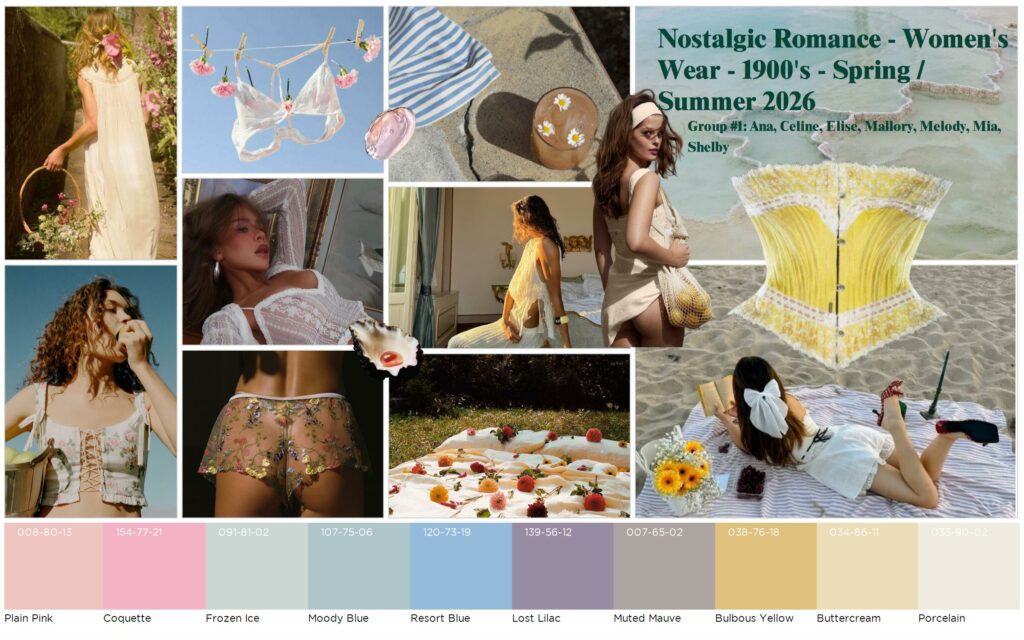
Original Fashion Image: The Corset
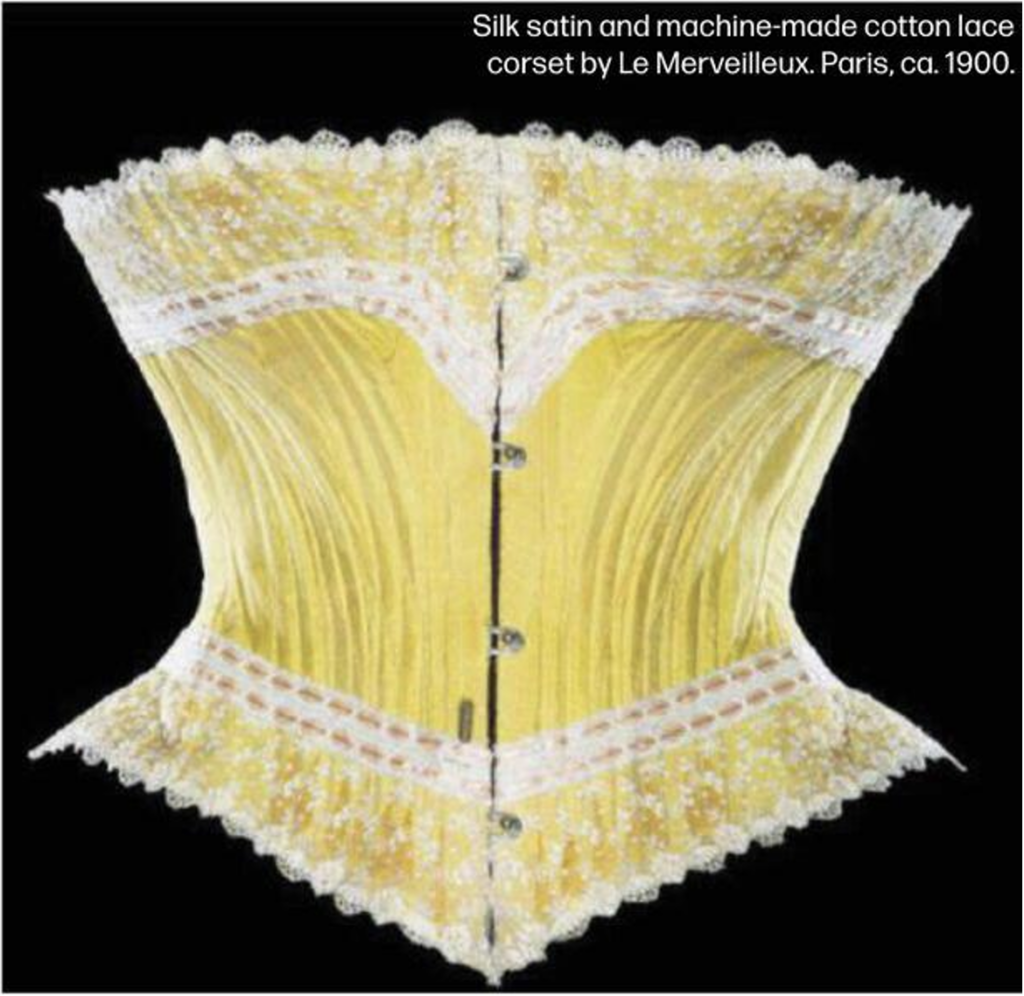
- Corset Source:
- Chikhoune, R. (2024). Fashion Scoops: Making a Statement. Wwd, 16. https://libproxy.txstate.edu/login?url=https://www.proquest.com/trade-journals/fashion-scoops-making-statement/docview/3113545177/se-2
Spring/Summer 26’ Season Trend Forecast:
- Details to pay attention to in the upcoming SS 26’ season are trims and how they are able to amplify a look. The Trims seasonal forecast for Spring/Summer 2026 explains why trims are in for this season, “Embracing the seasonal change right in time for getaways and celebrations, trims have a unique opportunity of amplifying the look and feel of existing products with a new vibrance. Prioritize beadings, prints and shine across decorative trims where possible.” Trims [Celine Caminos]
- There are predictions of an uptrend in mixed metals used in trims/accents according to the Trims seasonal forecast for Spring/Summer 2026. “Channeling a sense of ancient futurism as highlighted in our SS 26 Design Aesthetic: Honored metal trims are exploring new and diverse combinations.” [Celine Caminos] Trims
- Large-scale placements and fractured imagery are recommended to evoke a sense of grandeur and nod towards the architectural influences of stained-glass windows. Application onto lightweight sheers, beautiful silkies, duchess satin, or charmeuse further emulates the nuances of light, which would be furthered by the inclusion of embellishment- pattern and graphic shifts mosaic Decoratif summer spring 26
- Decorative details such as filigree, floral carvings and concrete moldings form a direction for intricate allovers and elaborate placements. Work with tonal color ways whilst considering embossing printing techniques, and lean into feminine silhouettes and shapes. -pattern and graphic shifts mosaic spring/summer 26, ornate harmony
Research
- Many women during the period in question continued to wear corsets for support. Indeed, it has been shown that, when properly worn, corsets could help women with their posture and yet, dress-reform literature of the day attacked corsets across the board as being too tightly laced and creating an idealized body shape that featured an unnaturally small waist (‘wasp waist’) that visually accentuated a woman’s hips, flattened her stomach and created an over-exaggerated bust that was sometimes described as a pigeon chest.
- The objective of corsets was to improve on the body type of every woman. Emphasis was on the waist. By the 1880s the corset had become an elegant and desirable object in a woman’s wardrobe with much attention paid to its design and execution. Corset makers and manufacturers took great pride in promoting excellent fit in ready-to-wear garments.
- The word “corset” itself comes from the French “corse”, which designates a bodice.
- For some women in the past the corset was an, “assault on the body” but for others wearing a corset represented positive implications of social status, self-discipline, respectability, beauty, youth, and erotic allure. Bloomsbury Fashion Central – Corset
- While in the 17-18th century corsets had a straighter shape to complement the ideal body type at that time and towards the end of the 18-19th century changed to fit a more hourglass physique.
- Corsets where originally made with whale bone and steel to perfect the panel to define the busk style and had laces for tightening
- While the above is an extreme example, a review of the Brooklyn Museum exhibition Of Corsets (1980–1982) provides an example of the cognitive dissonance created by being confronted with such different conceptions of the body; New York Times journalist Bernadine Morris wrote, ‘Tucked away in a [sic] obscure corner of the fourth floor of the Brooklyn Museum devoted to decorative art is a compact exhibit of antique objects displayed on wire forms suspended from the ceiling. When viewed as abstract shapes bearing some relationship to the human torso, the exhibit has a certain charm, enhanced by exquisite workmanship: rows of tiny, even stitches made by hand; rims of frothy lace; the most delicate embroideries. But when viewed in terms of use these objects were actually put to, it can be seen as a chamber of self-inflicted horrors as women tortured themselves in subjugation to the whims of fashion. For this is an exhibit of corsets, the earliest dating back to around 1780, the latest around 1950, and it is mute testimony to the distortion of the human body through the ages.’ (Morris 1980: C18)
- Curators at the institutions examined in this research seem to have been very aware of the ambiguous relationship between the body and fashion, and exhibitions featuring undergarments or revealing clothing demonstrate this particularly well. The Brooklyn Museum 1980 exhibition Of Corsets has already been discussed above, but it was preceded in 1939 by an exhibition entitled Style Foundations: Corsets and Fashions of Yesterday and Today, which also154 displayed the material means by which women’s bodies were changed for similar ends in different ways: ‘You breathe freely in modern corsets for modern corsets are not the old fashioned torture chamber affairs that caused ladies to faint and long treatises to be written about health. The rigid, unyielding corsets of our grandmothers and great-grandmothers have been replaced by soft garments with skillfully placed gores of elastic that give with every breath and motion of the body. […] The cycle of fashion is back to wasp waists, hips and high rounded bosoms; but the superb health of the modern woman will not be touched at all. Women’s waists will be two inches smaller and look as if they could be spanned with two hands; but they’ll breathe as freely as ever.’ (“Tighten Your Stays” 1939) Here, historical fashion was placed in contrast to modern technology. Although the conception of the ideal body had not changed between Victorian times and the 1930s, the text tells us, the acceptable means by which this was achieved had.
- At the Costume Institute of the Met, Richard Martin and Harold Koda collaborated on two exhibitions in 1994 and 1996, both of which traced the variations in the relationship between the body and clothing over time. Waist Not (1994) described ‘the physical and representational ideals of the human body through history. […] But fashion’s inconstant waist is not a sign for body subjugation. Rather, its changes and options suggest that fashion assumes a task of rendering more similar, at least in ideal form, the range of human bodies.’ (Martin and Koda 1994: n.p.)
Sources
Wieber, S. (2021). Reformers: Dressing the part. In Jugendstil Women and the Making of Modern Design (pp. 147–182). London: Bloomsbury Visual Arts. Retrieved March 2, 2025, from http://dx.doi.org/10.5040/9781350088559.0011)
Petrov, J. (2019). The Body in the Gallery: Revivifying Historical Fashion. In Fashion, History, Museums: Inventing the Display of Dress (pp. 137–166). London: Bloomsbury Visual Arts. Retrieved March 15, 2025, from http://dx.doi.org/10.5040/9781350049024.ch-007